The History of Radio Frequency Interference and Causes

The History of Radio Frequency Interference and Causes

Radio frequency interference, commonly known as RFI, is a term that harkens back to the onset of telegraph lines and radio towers. Today, RFI is encompassed by the much broader term of EMI (Electromagnetic Interference). Since the invention of the transistor, electronic devices have incorporated high frequency switching techniques to transform power and enter in the digital age. Today, this technology is used in almost every device that can be found in our homes, offices, cars and airplanes.

With the digital age comes greater sensitivity of circuit operation to externally generated RF or EMI noise. These circuits can operate at millivolt and microvolt levels making them vulnerable to even low levels of induced noise. Have you ever wondered why you need to shut off your mobile phones when the plane takes off or lands? Or why your car radio produces a buzzing sound just before your mobile phone rings? It is because electronic devices that operate within the crowded landscape of frequencies interfere with each other.

The presence of unwanted signals or noise generated by power and digital fast switching circuits is increasing at a rapid rate. This noise can conduct down power lines as well as radiate from power and signal lines and couple into other equipment. Military and commercial standards have been created to establish noise limits that an equipment can conduct and radiate. The test frequency range is very broad and is primarily concerned from 10Khz to 10Ghz.

In the design of electronic products, EMI or RF interference must be addressed at each stage of product development. From initial analysis to board layouts and circuit topology and ICs used. Therefore, determining compliance and defining the techniques and materials to be used to mitigate an equipment’s emissions and susceptibility vulnerability is critical. In general, two of the more prominent techniques involve the use of shielding and filtering.

rf shielding

RF shielding incorporates the use of metals to reflect and/or absorb radiated noise so that it does not radiate into the surrounding environment. In addition to the metal used for the chassis or box design, bonding, penetrations and openings must be designed in order to maintain the overall shield integrity. Additional techniques include PCB design, cable routing and shielding, grounding and circuit compartmentalization.

The use of EMI filters is critical in controlling noise generated within a PCB and at equipment power and signal egress points. The majority of designs incorporate passive techniques using capacitors and inductors. These components are designed to provide mismatched circuit impedances to contain noise voltages and currents within an equipment or system so that they do not propagate into the external environment.
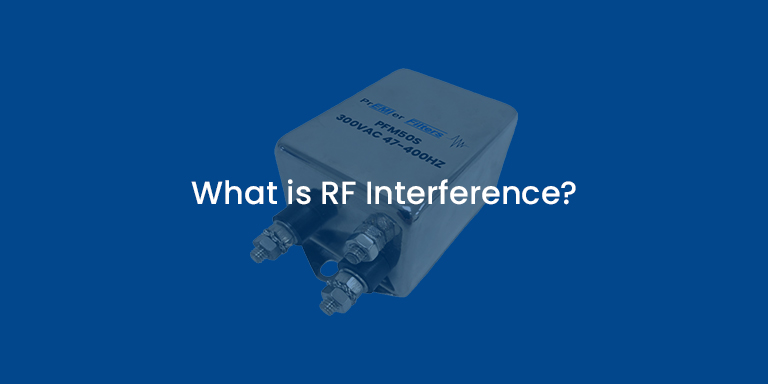
What is RF Interference?

What is RF Interference?

RF Interference (RFI) or EMI (Electromagnetic Interference) is an invisible phenomenom that is all around us. In general, it is created by sharp changes in circuit voltage and current (di/dt, dv/dt). Lines across an older TV when you operate a vacuum cleaner, a blown LED light when the AC turns on, or an AM radio being drowned out when using a treadmill are all examples of RF Interference. RF stands for Radio Frequency and RFI was originally used to describe interference caused by radio transmissions. As electronics and technology have progressed, RFI has been replaced by the broader term EMI.

The issues related to RF interference are increasing daily with the usage of mobile phones and other consumer electronics, residential solar inverters, smart appliances and the continual proliferation of high frequency switching for power conversion. In the design and manufacture of electronic products, RF interference control plays a critical factor in each stage of product development. There are many criteria associated with achieving proper RF interference control in an equipment. Three key factors are shielding, PCB design and filtering.

1. Shielding


Shielding is the use of metals such as copper, aluminum and steel to contain RF Interference

Shielding is the use of metals such as copper, aluminum and steel to contain RF Interference at the equipment level, to shield sensitive circuits or for targeted radiation control. Proper application is needed to achieve the desired performance. Metal to metal bonding, metal type and thickness, ventilation design, cable design, lid/seam design, etc. are all factors that need to be considered. Regarding cable shields, proper termination is critical, with 360 degree terminations being optimal. Depending on frequency, the use of shield drain wires can be used. However, the longer the drain wire, the greater chance of shield degradation.

2. PCB Design


PCB design is critical in controlling radiation from logic and control circuits

PCB design is critical in controlling radiation from logic and control circuits. Implementation of bypass filtering, circuit loop control and multi-layer boards are just some of the techniques used by designers to control and reduce radiation form logic boards.

3. Filtering

The use of filtering to reduce RF Interference plays a key role in conducted, as well as radiated emission control. Power line filters, cable and I/O filters installed at an equipment’s point of egress are critical to controlling noise from propagating into other electronic equipment. Filter location, case design, bonding, cable routing, etc. are just some of the factors to consider to achieve optimum filter performance.

In summary, RF Interference control and mitigation plays a critical role in equipment design. At Premier Filters, we address all aspects of an equipment’s RFI/EMI design to deliver the right filter at the right price.