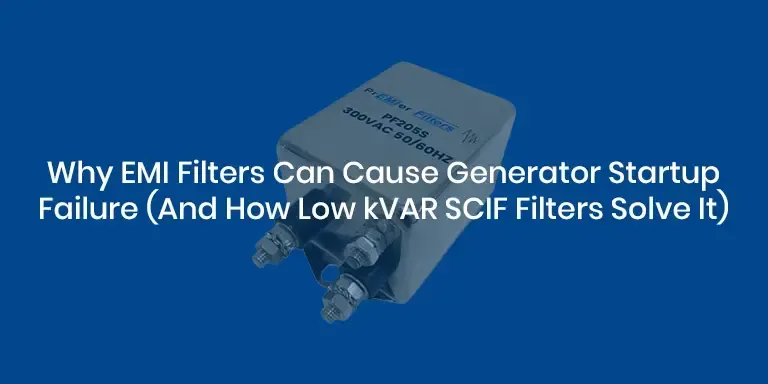
Why EMI Filters Can Cause Generator Startup Failure (And How Low kVAR SCIF Filters Solve It)
Introduction
In mission-critical environments such as SCIF facilities, data centers, and defense installations, backup power is not optional, it is essential. However, a commonly overlooked issue can prevent emergency generators from starting: high kVAR EMI filters.
While EMI filters are necessary for compliance and system protection, traditional designs can introduce excessive reactive power, creating serious problems during generator startup. Understanding this issue and how low kVAR SCIF EMI filters solve it is critical for engineers, contractors, and facility operators.
What Do EMI Filters Do?
EMI (Electromagnetic Interference) filters are installed at the power entry point to suppress unwanted electrical noise and ensure compliance with standards such as:
- FCC and CE regulations
- MIL-STD requirements
- SCIF 100 dB attenuation specifications
These filters are designed to attenuate conducted and radiated emissions across a broad spectrum, typically ranging from 14 kHz to 40 GHz, covering both low-frequency conducted interference and high-frequency radiated threats.
Most EMI filters use passive components – inductors and capacitors to achieve effective attenuation across this wide frequency range. However, these same components can introduce reactive power (kVAR) into the system.
The Hidden Problem: High kVAR in Traditional EMI Filters
Many conventional SCIF EMI filters rely heavily on capacitive elements to achieve high attenuation (e.g., 100 dB). This design approach often results in high kVAR, which can:
- Increase apparent power demand
- Overload generator capacity
- Cause voltage instability
- Prevent generator startup altogether
Why This Matters During Emergency Power Transfer
When a facility switches to backup power:
- The generator must quickly stabilize voltage and frequency
- High reactive loads (kVAR) create a heavy initial burden
- The generator may fail to start, trip, or shut down
In worst-case scenarios, this results in loss of emergency backup power
This risk is especially critical in:
- SCIF environments
- Military installations
- Critical infrastructure systems
The Solution: Low kVAR SCIF EMI Filters
Advanced engineering now enables low kVAR EMI filter designs that maintain high attenuation without compromising generator performance.
Premier Filter’s low kVAR SCIF EMI filters:
- Meet 100 dB attenuation requirements
- Operate effectively across 14 kHz to 40 GHz
- Minimize reactive power demand
- Ensure reliable generator startup
- Maintain full compliance with military and commercial standards
How Low kVAR Design Improves Generator Performance
1. Reliable Generator Startup
Reduced reactive load allows generators to start and stabilize during emergency conditions.
2. Improved Power Quality
Lower kVAR reduces voltage distortion and system stress.
3. Increased System Efficiency
Minimizing reactive power improves electrical efficiency.
4. Enhanced Mission Readiness
Ensures backup systems function when needed most.
Engineering Challenge: Achieving 100 dB with Low kVAR
Designing a 100 dB SCIF EMI filter that performs across 14 kHz to 40 GHz while maintaining low kVAR is a significant technical challenge.
It requires:
- Advanced filter topology
- Optimized inductive/capacitive balance
- Broadband attenuation design techniques
- Deep expertise in electromagnetic behavior
Few manufacturers have successfully achieved this balance, making it a key differentiator.